The copper pot that dances in Chengdu teahouses
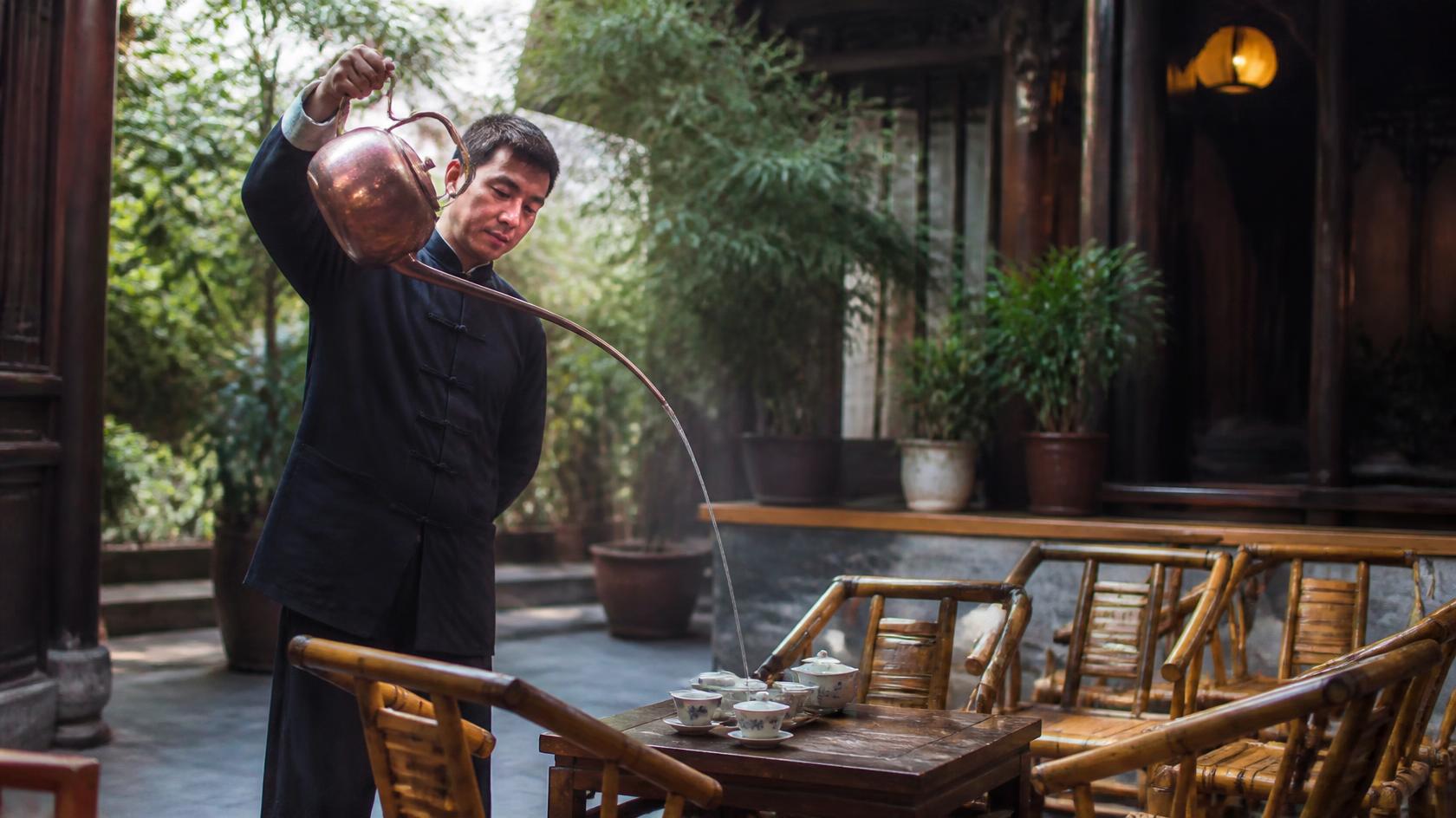
Walk into Heming Teahouse in Chengdu's People's Park and the first thing you notice is not the tea. It is the arc of a copper spout cutting through the air, sometimes longer than the server is tall, pouring a thin stream of boiling water into a cup from arm's length away[source:4]. The long-spout teapot is not a prop. In Sichuan, it is a way of serving tea that turned into an art form.
Locals call it longzuihu chayi — long-spout teapot tea art. To outsiders it looks like kung fu with a kettle. To the teahouse, it is a practical tool made beautiful by centuries of use.
From river-port service to performing art
The long-spout pot first appeared in the Tang dynasty and Five Dynasties period, in riverside teahouses along the Tuo River and the Yangtze around Chengdu. Sichuan was already a major tea producer, and the river ports were crowded with boatmen, merchants, and travelers in a hurry. Waiters needed to reach several tables at once without pushing through the crowd, so they lengthened the spout. A single server could stand in one spot and pour for guests seated meters away[source:5].
The original purpose was efficiency. The beauty came later. As the teahouses grew, attendants began adding flourishes — a twirl of the wrist, a high pour, a low bow — to entertain guests and show skill. By the time the Mengshan school codified its forms, the pour had absorbed martial arts stances, dance steps, acrobatic balance, and the body language of Sichuan opera.
The Mengshan school and Dragon 18 Styles
The best-known school today is the Mengshan school from Mengding Mountain in Ya'an, Sichuan. It organized the long-spout repertoire into the Long Xing Shi Ba Shi — the Dragon 18 Styles[source:3].
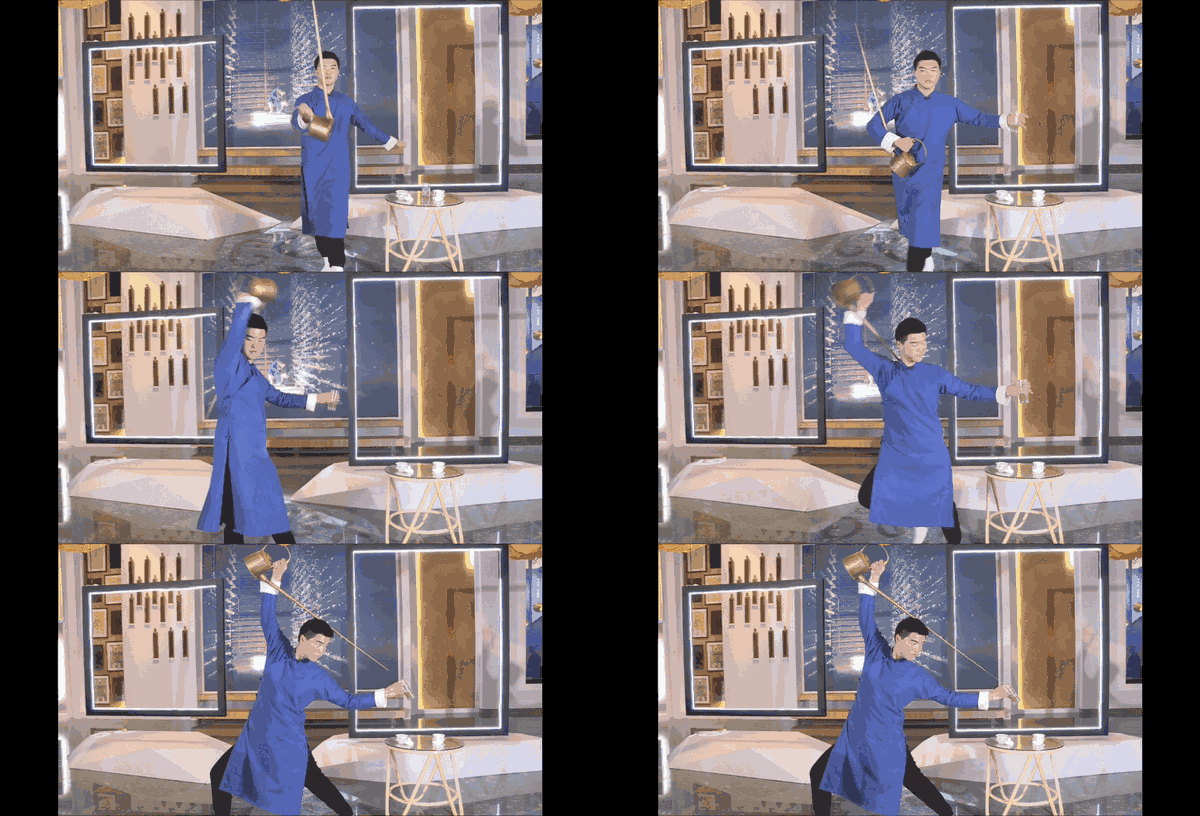
Each style borrows a dragon's movement. The names alone tell you the choreography is athletic: Jiao Long Chu Hai (Dragon Leaves the Sea), Bai Long Guo Jiang (White Dragon Crosses the River), Wu Long Bai Wei (Black Dragon Swings Its Tail), Fei Long Zai Tian (Flying Dragon in the Sky)[source:3]. In performance the tea master flips, spins, and extends the pot, yet the water still lands cleanly in the cup. The audience sees a dragon in motion; the guest simply receives a cup of tea.
There are also separate men's and women's forms. The men's Dragon 18 Styles emphasize power and height; the women's Phoenix Dancing 18 Styles favor fluidity and grace. Both require years of practice to control a copper pot with a spout that can extend close to a meter.
What the moves mean
Unlike Japanese sadō, where every gesture points inward toward stillness, Sichuan long-spout tea art faces outward toward the guest. The pour is a greeting. The height of the spout shows respect; the steadiness of the stream shows control; the final bow shows that the server, not the guest, has done the work.
The physics are real. Water cools as it travels through the air, so a high pour can bring boiling water down to the right temperature for green tea by the time it reaches the leaves. The long spout also creates a gentle aeration, similar to the way a sommelier decants wine. What looks like theater is also functional tea brewing.
A heritage that pours tea from a meter away
In 2019, Sichuan long-spout tea art stepped onto a diplomatic stage. During the eighth China-Japan-South Korea leaders' meeting in Chengdu, tea artist Song Siyi performed for Premier Li Keqiang and South Korean President Moon Jae-in. After the performance, Premier Li shook her hand and praised the skill, then explained it to President Moon[source:1][source:2].
Three years later, the "Tea and World · Sharing Intangible Heritage" event at the Sichuan Intangible Cultural Heritage Museum featured the Mengshan school's Dragon 18 Styles in a live-streamed program. The event reached more than three million online viewers[source:3]. Long-spout tea art is no longer confined to teahouse floors; it is one of the most visible faces of Chinese tea culture abroad.
The art also sits inside a larger UNESCO recognition. In 2022, "Traditional tea processing techniques and associated social practices in China" was added to the Representative List of the Intangible Cultural Heritage of Humanity. Sichuan's long-spout tea art is part of that social practice — the performance side of a tradition that begins with the leaf and ends with the guest.
Where to see it and why it matters
The easiest place to watch long-spout tea art is still a Chengdu teahouse. Heming Teahouse, founded in 1923 in People's Park, is the city's oldest surviving teahouse and a living stage for the form[source:4]. Arrive in the morning, order a cup of green tea, and wait. Eventually a server will appear with a copper pot, ask if you are ready, and pour from a distance that seems impossible.
For visitors, the lesson is simple: Chinese tea art is not only the quiet precision of Gongfu Cha in Chaozhou. It is also the theatrical generosity of Sichuan, where the server moves so the guest does not have to. Both traditions ask the same thing — that the tea be served with skill, and that the guest feel at home.