Chinese Tea Art vs Japanese Tea Ceremony: Same Root, Different Paths
Western travelers often arrive at Chinese tea through Japanese tea ceremony. They have seen the quiet room, the bamboo whisk, the single bowl of matcha. Then they sit down to a Gongfu Cha session and find something else entirely: a small pot, many tiny cups, conversation, and round after round of the same leaves. The two traditions share ancestors, but they diverged centuries ago and now answer different questions.
Two ceremonies, one leaf
Both Chinese tea art (chayi, 茶艺) and Japanese tea ceremony (sadō or chadō, 茶道) grew from the same soil: the tea culture of Tang and Song dynasty China. Monks, merchants, and diplomats carried tea and tea knowledge across the East China Sea to Japan. Over time, each country shaped the practice to fit its own values. China kept tea close to daily life and taste. Japan raised it into a disciplined aesthetic and spiritual form.
The easiest way to see the difference is to watch what happens at the table.
Where Japanese tea ceremony came from
The Japanese tea ceremony traces its formal origins to the Jingshan Tea Banquet (Jingshan chayan, 径山茶宴) at Jingshan Temple in Zhejiang province. According to the Yuhang County Gazetteer, the temple's founder, Master Faqin, offered "Buddhist tea" as early as the Tang dynasty. By the Song and Yuan dynasties, the banquet had become a structured ritual for receiving honored guests, with more than ten steps: posting the tea notice, striking the tea drum, inviting guests into the hall, burning incense, boiling the tea, whisking it, serving it, reciting verses, and finally thanking the guests and leaving.
The heart of Jingshan Tea Banquet was chan cha yi wei — the unity of Zen and tea. Monks and guests drank tea together and engaged in "question-and-answer" exchanges, using sharp, playful language to point toward insight. When Japanese monks studied at Jingshan Temple, they took this ritual home. Over centuries, Japanese tea masters such as Murata Jukō, Takeno Jōō, and Sen no Rikyū refined it into what became sadō. In 2022, Jingshan Tea Banquet itself was recognized as part of China's UNESCO entry "Traditional tea processing techniques and associated social practices in China."
What Chinese tea art means today
If Japanese tea ceremony asks, "How can one bowl of tea make this moment perfect?" Chinese tea art asks, "How can the same leaves keep surprising us?"
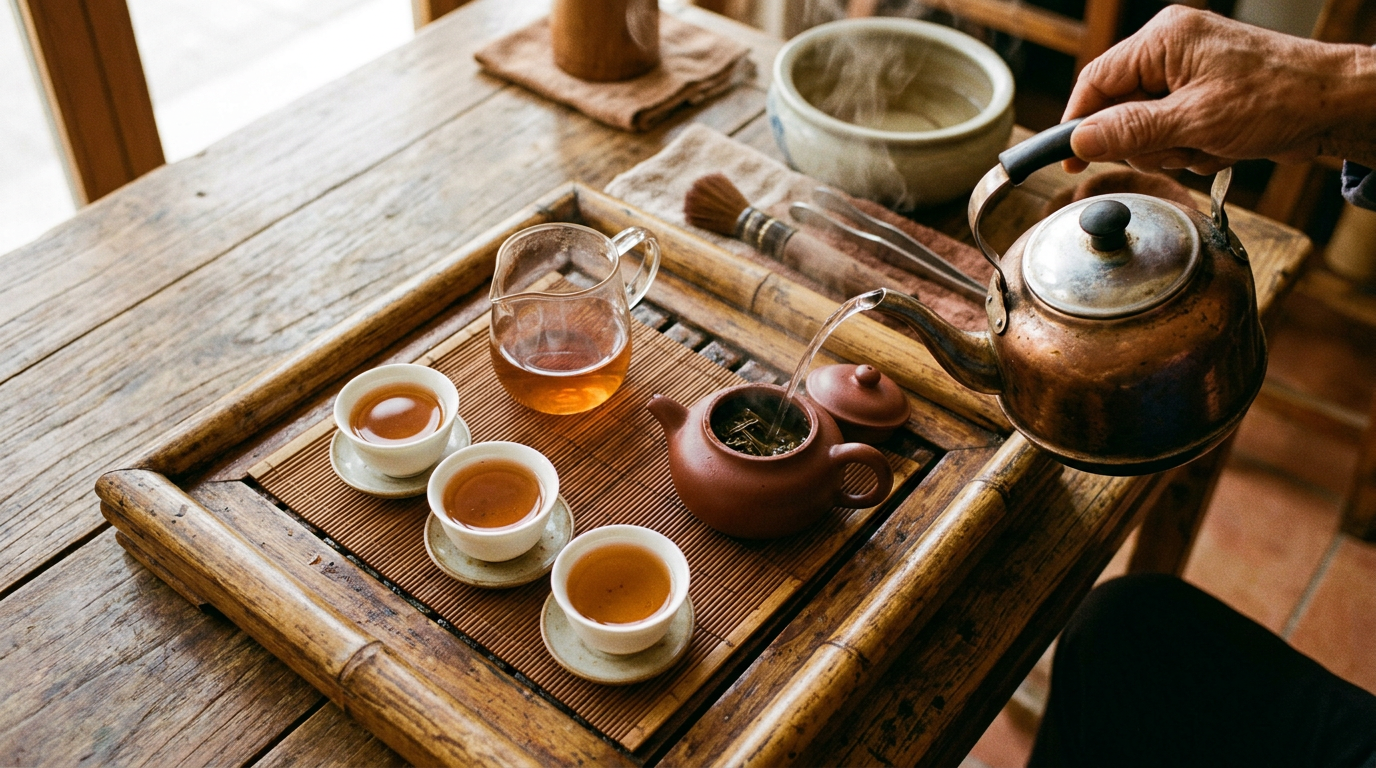
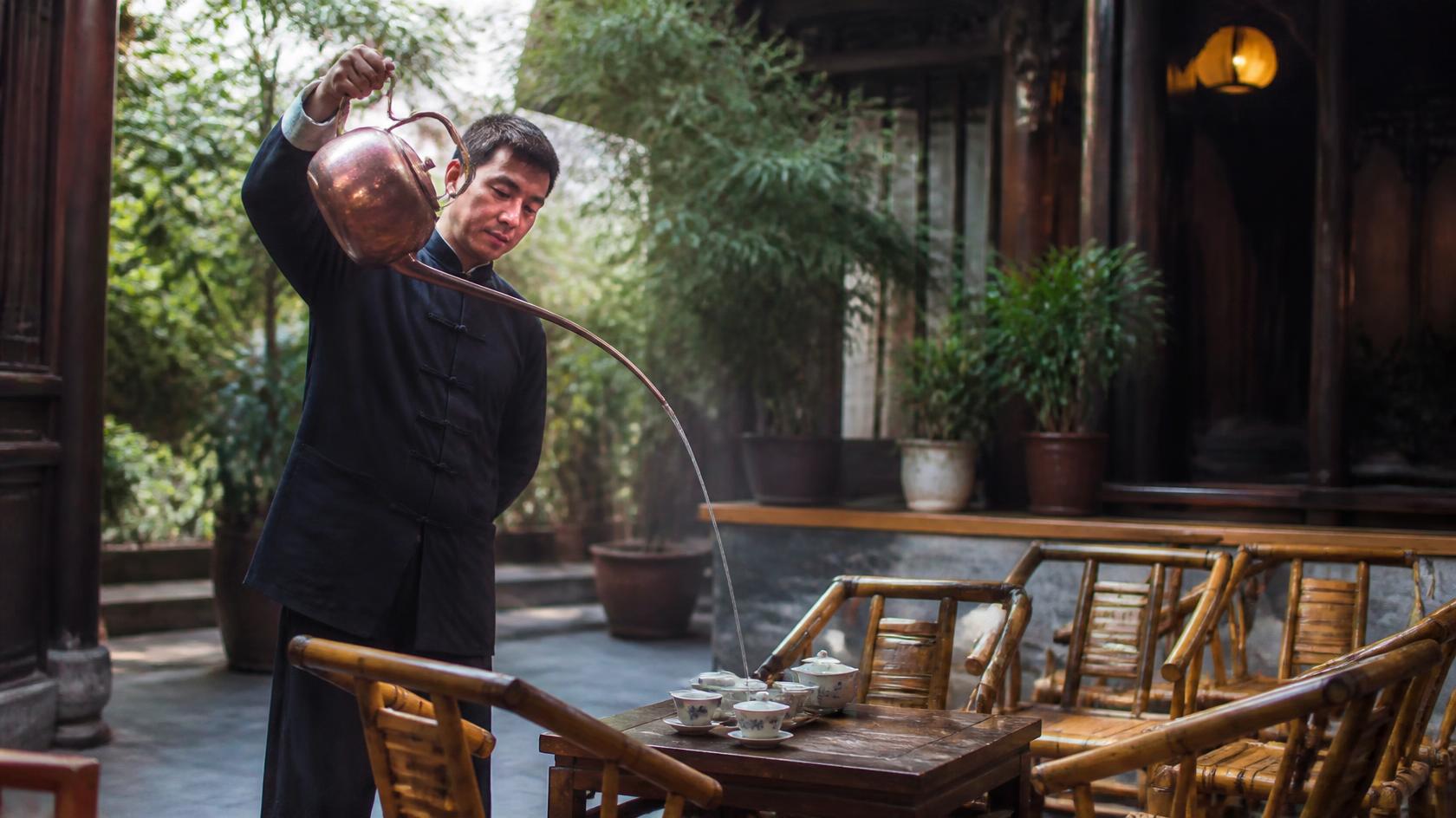
The most complete living example is Chaozhou Gongfu Cha, listed as a national intangible cultural heritage in 2008. Its twenty-one steps move from presenting the teaware to warming the pot, rinsing the leaves, brewing with a high pour, and serving through the famous "Guan Gong patrols the city" circular pour. The tea is usually a rolled oolong — often Phoenix Dancong from Chaozhou — and the same leaves are steeped five, ten, or even fifteen times.
Unlike the fixed choreography of sadō, Gongfu Cha is flexible. The host adjusts timing and water to the leaf and to the guests. Conversation flows. The pot is small, the cups are smaller, and the point is to taste how the tea changes with each infusion.
Side-by-side comparison
| Chinese Gongfu Cha | Japanese sadō | |
|---|---|---|
| Tea | Loose-leaf oolong, pu-erh, red tea | Powdered matcha |
| Vessel | Small clay pot or gaiwan | A single wide tea bowl |
| Preparation | Many short infusions from the same leaves | One bowl, whisked and drunk immediately |
| Group size | Small group, often conversational | One to five guests, usually quiet |
| Focus | The taste of the leaf, infusion by infusion | The totality of the gathering |
| Ideal | Harmony between host, guest, and tea | Ichigo ichie — one time, one meeting |
| Setting | Tea tray, small cups, everyday table | Tearoom with scroll, flower, and kettle |
Tea: what is in the bowl
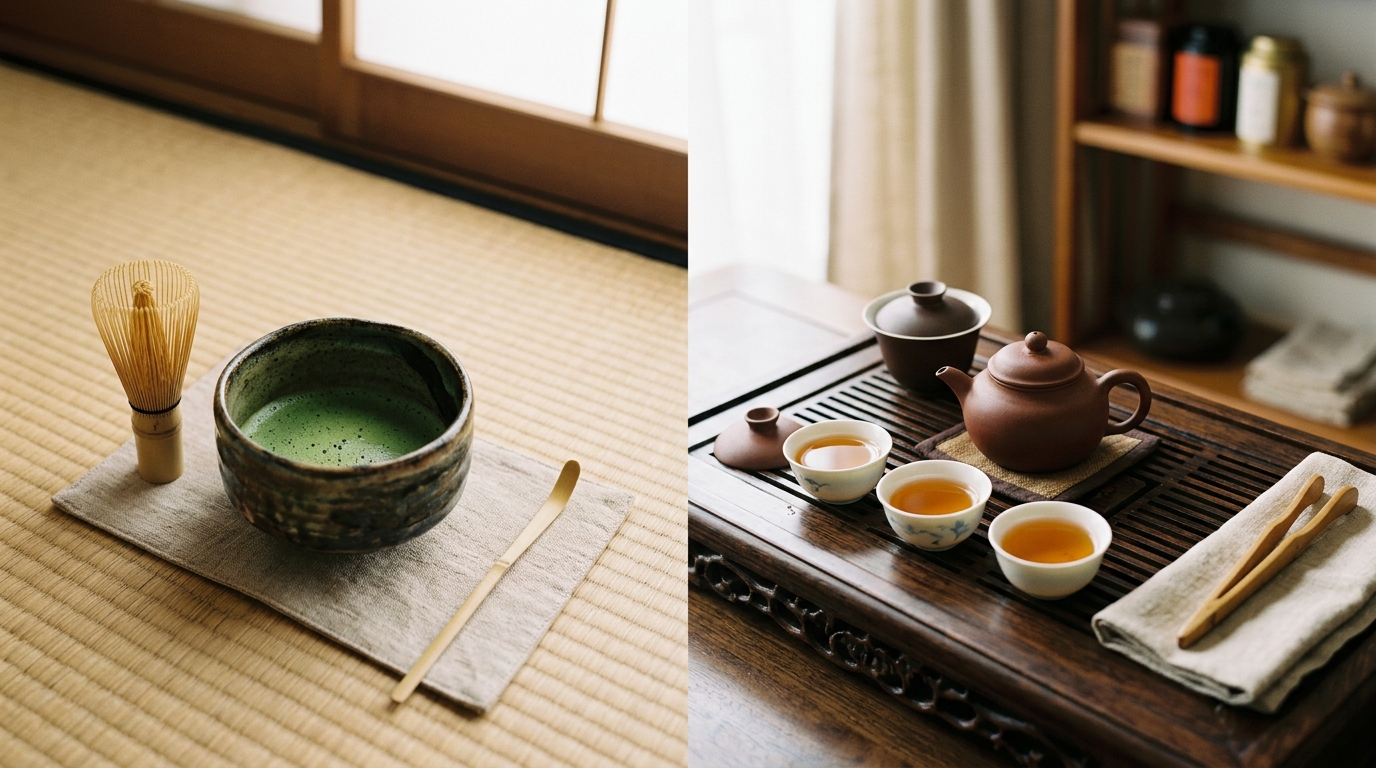
In sadō, the tea is matcha: shade-grown tea leaves steamed, dried, and ground into a fine green powder. The host whisks the powder with hot water until a soft foam appears, then hands the bowl to the guest. The guest rotates the bowl, drinks in two or three sips, and wipes the rim. There is one bowl per guest, and the act is complete.
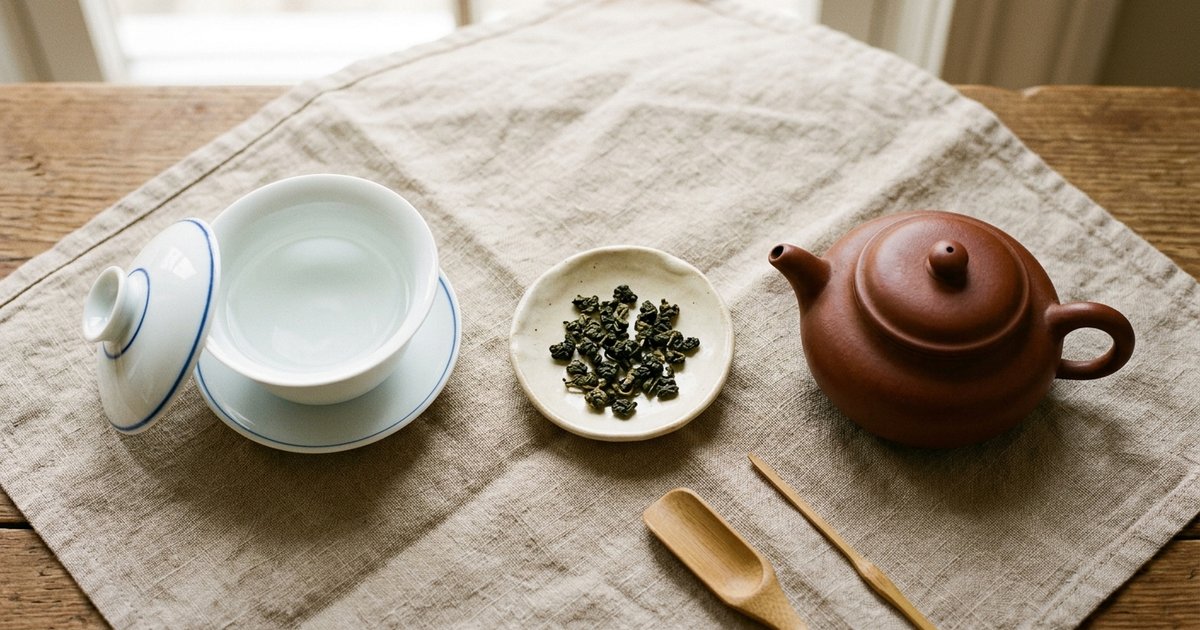
In Gongfu Cha, the tea is whole, rolled leaves. The host rinses them once, then brews repeated infusions of ten to thirty seconds. Each round tastes different: the first might be floral, the third sweeter, the fifth more mineral. The guest smells the empty cup after drinking, because a good oolong leaves a fragrance that outlasts the liquid.
Vessel and movement
The Japanese tea bowl (chawan) is wide and open, designed to be held with both hands and admired before drinking. The whisk (chasen) is made from a single piece of bamboo split into dozens of fine prongs. The movements are prescribed: how the whisk enters the bowl, how the bowl is lifted, how the guest bows.
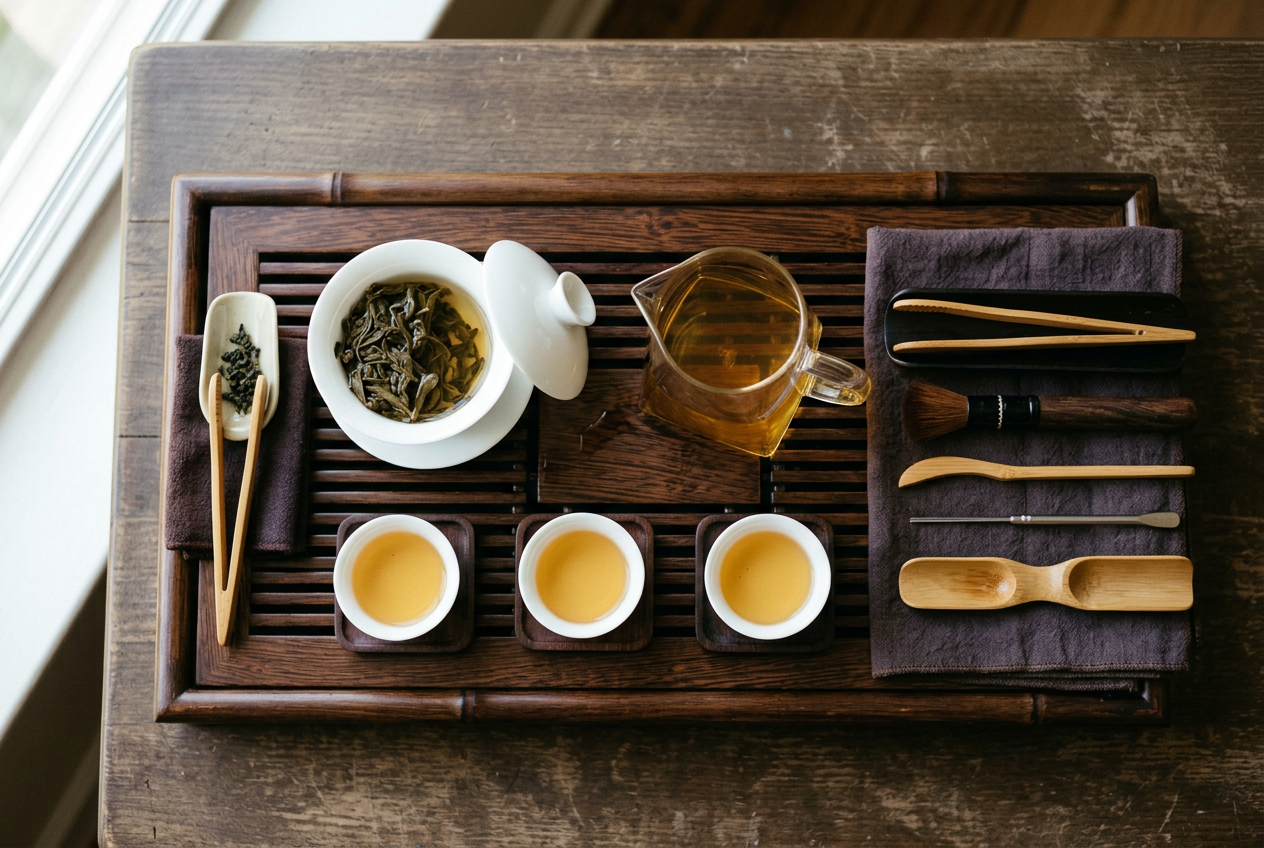
The Chinese Gongfu pot is small, sometimes only 100 ml, with a lid that becomes a tool for scraping foam and checking aroma. The fairness pitcher (gongdao bei) makes sure every cup has the same strength. Three small cups sit on a tray and are passed from hand to hand. The movements are skilled but not rigid; the host may chat, refill the kettle, or adjust the next infusion based on what the last one tasted like.
Spirit and purpose
Japanese sadō is built on 和敬清寂 (wa-kei-sei-jaku): harmony, respect, purity, and tranquility. The tearoom is removed from ordinary life. The scroll and flower set the season. The host has prepared for this single meeting, and the guest enters a space where nothing else matters. Ichigo ichie — one time, one meeting — means this gathering will never happen again, so it deserves full attention.
Chinese Gongfu Cha is built on 和 (he), harmony, but harmony of a different kind. As Pan Yashun of the Chaozhou Intangible Cultural Heritage Protection Center has explained, Gongfu Cha reflects the local ideal of harmony between people, between person and nature, and between the present moment and a long tradition. The ritual serves the guest. The tea serves the conversation. The form is important, but it is never allowed to override warmth and practicality.
Which one should you learn?
Choose Japanese tea ceremony if you want a structured, meditative practice with clear levels of mastery, a strong aesthetic, and a sense of stepping outside ordinary time.
Choose Chinese Gongfu Cha if you want a social, taste-centered practice that you can adapt to your kitchen table, your favorite tea, and your friends.
Neither is better. They are answers to different questions. One perfects the moment. The other unfolds the leaf.
Frequently asked questions
Did Japanese tea ceremony come from China? Yes. Its formal origins trace to the Jingshan Tea Banquet at Jingshan Temple in Zhejiang, which Japanese monks encountered during the Song and Yuan dynasties.
Is matcha Chinese or Japanese? Matcha as we know it was developed in Japan, but powdered tea was already used in Song dynasty China. The Chinese later moved to loose-leaf brewing, while Japan preserved and refined the whisked form.
Can I practice both? Absolutely. Many tea people do. The skills do not conflict; they simply train different sensitivities.
Which is older? Tea drinking in China is older by more than a thousand years. The Japanese tea ceremony took its mature form later, from the fifteenth century onward.
Is Gongfu Cha a ceremony or just brewing? It is both. At home it can be as simple as a small pot and a few cups. In Chaozhou it is performed as a twenty-one-step heritage art. The same actions scale up or down.