Setting the scene
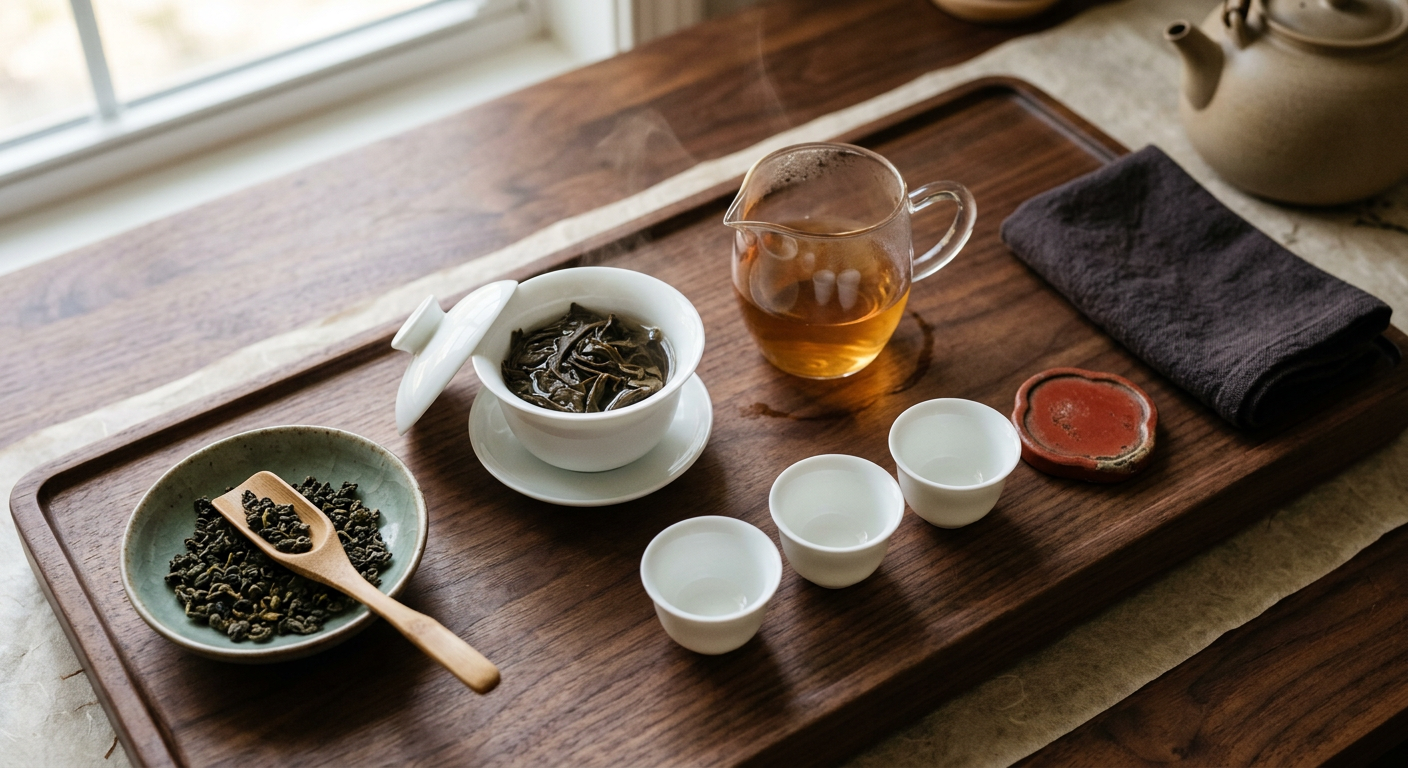
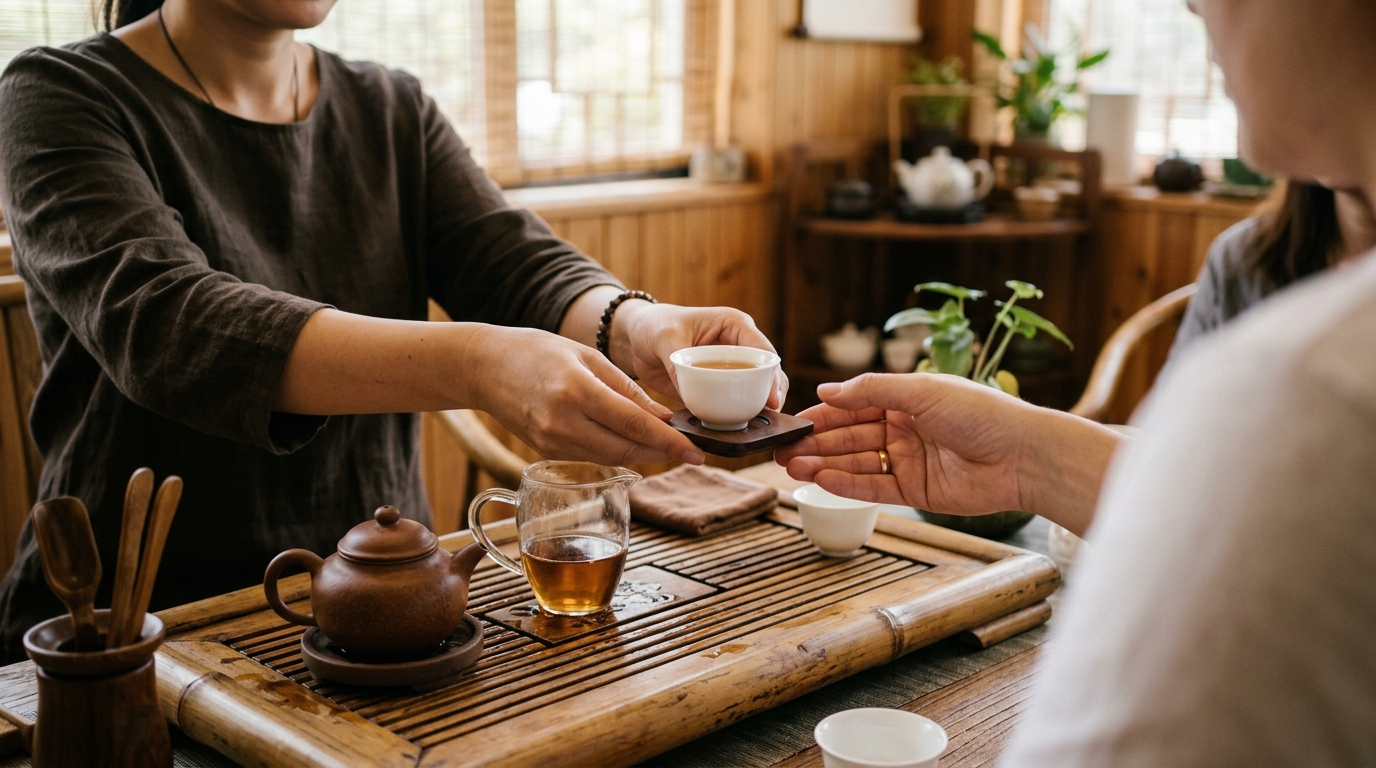
Late afternoon light falls across a low wooden table. A small kettle hums on a side warmer. You have arranged three tiny cups, a glass pitcher, and a white porcelain gaiwan on a slatted tea tray. Beside them sits a small dish of rolled oolong leaves, dark and slightly oily, with a fragrance that rises even before water touches them. A friend sits across from you. No phones. No hurry. Just the sound of water cooling toward the right temperature and the soft clink of porcelain as you lift the lid.
This is how to host a Gongfu tea ceremony at home.
The tea is not the ceremony. The gathering is. The leaves are simply the excuse to slow down together.
The term Gongfu Cha (工夫茶) is often translated as "Chinese tea ceremony," but its literal meaning is more useful: making tea with skill[source:1]. It is not a fixed liturgy. It is a method developed over centuries to extract the fullest aroma, sweetness, and texture from fine leaves through small vessels, a high leaf-to-water ratio, and many short infusions.
What makes a ceremony
A ceremony, in the Gongfu sense, is simply an intentional way of serving. The tradition took recognizable shape in the Chaozhou region of eastern Guangdong during the eighteenth and nineteenth centuries, where farmers and merchants brewed the local aromatic oolongs in tiny pots and cups because that was the way to honor the leaf[source:1]. The style became so characteristic of the area that "Chaozhou Gongfu Cha" is now treated as a single phrase. In 2008, the tea art of Chaozhou was inscribed on China's national list of intangible cultural heritage; in 2022, traditional Chinese tea processing techniques and their associated social practices were added to UNESCO's Representative List of the Intangible Cultural Heritage of Humanity[source:2][source:3].
That social element matters. Gongfu Cha is usually brewed for others. The host watches the leaves, controls the water, and serves the guests. The guests receive with both hands, taste in small sips, and pay attention. The conversation moves slowly, guided by the rhythm of the kettle.
If you want to understand the roots of this method, our article on what is Gongfu Cha covers the history and principles in more depth.
Gather your tools
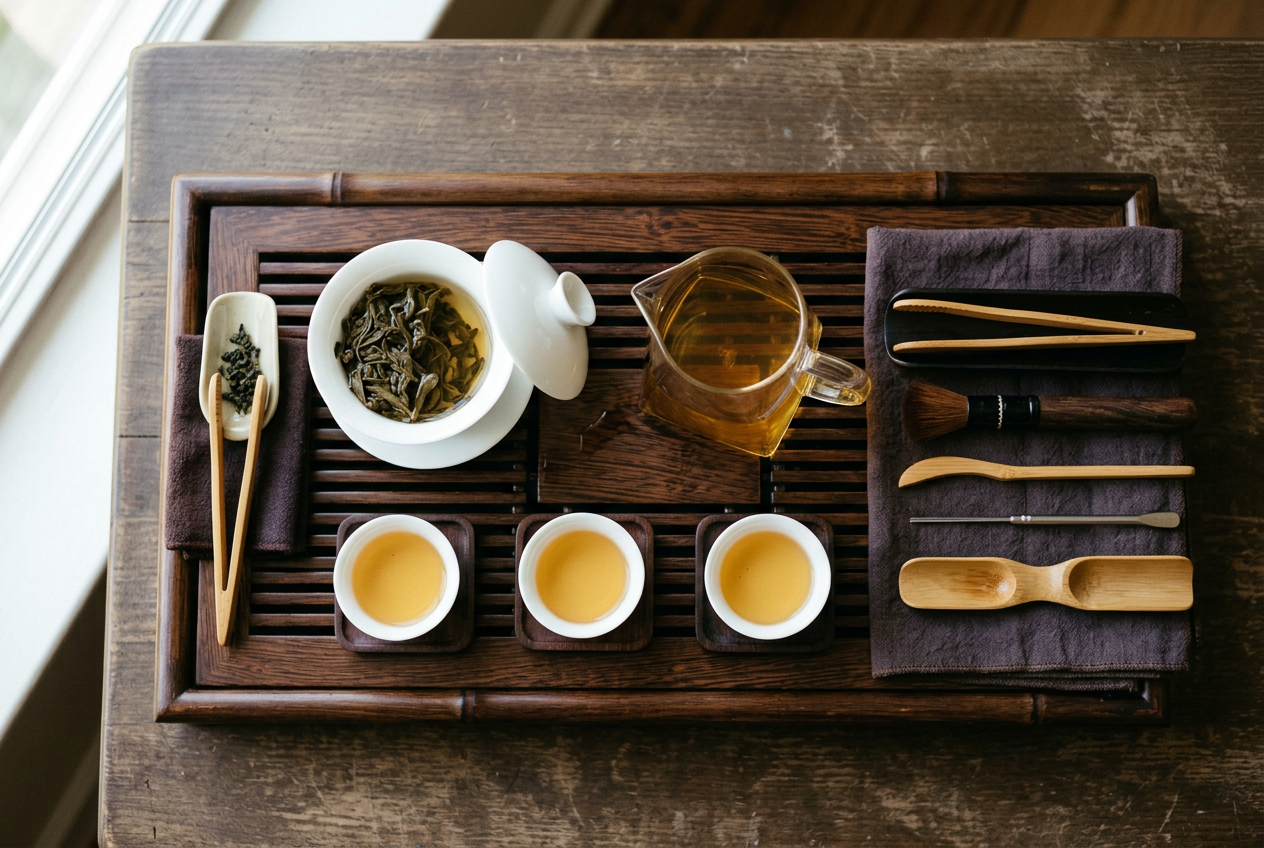
You do not need a room full of antiques. A modest Gongfu tea set will do:
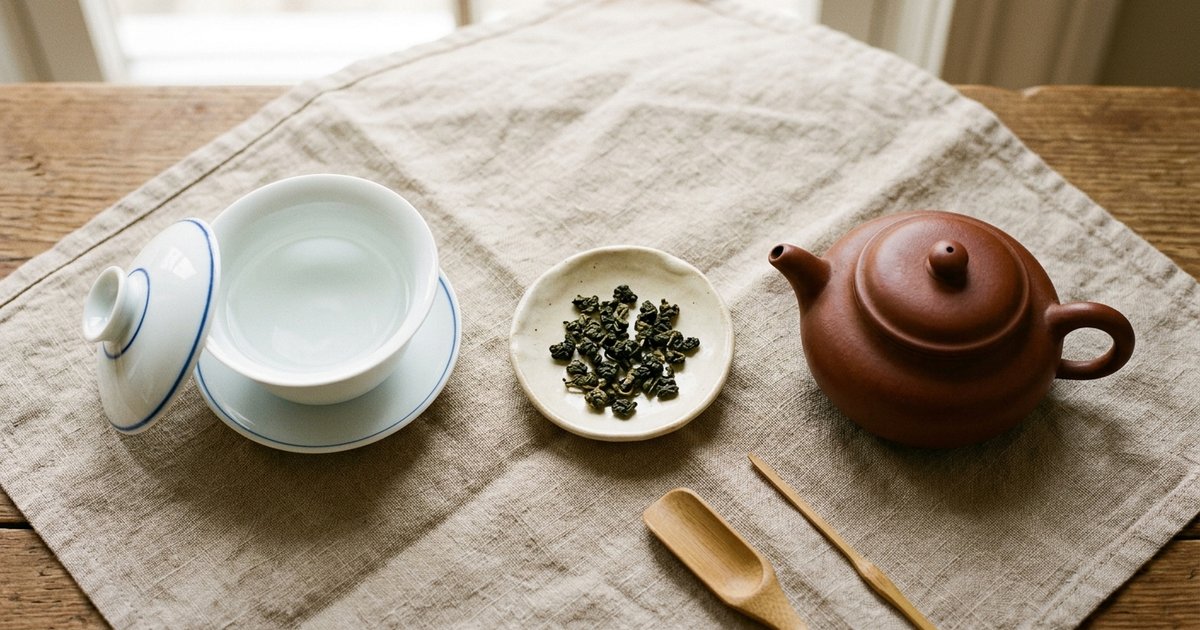
- A small brewing vessel. A 100–150 ml porcelain gaiwan is the most versatile starting point. It shows the leaves clearly, pours quickly, and works for almost every tea family. Later you may want a small Yixing teapot for oolong or pu-erh.
- A fairness pitcher (公道杯, gongdao bei). After each infusion, pour the liquor into this pitcher before dividing it among cups. The brew continues to extract in the gaiwan; moving it to a pitcher stops steeping and gives everyone tea of the same strength.
- Small tasting cups. Three is the traditional Chaozhou number, but two or four work fine. Thin white porcelain is ideal because it shows the color of the liquor and cools quickly.
- A tea tray or tea boat. This catches rinse water and overflow. Choose one with a drain or reservoir so the table stays calm.
- A tea scoop and a small dish. Use these to measure and display the dry leaves.
- A kettle that reaches a full boil. Temperature control helps, especially when you begin.
Optional additions include a tea strainer, aroma cups for smelling the lid, tea tongs, and a tea pet. Add them only when the basic flow feels natural.
Prepare water and leaves
Good tea cannot rescue bad water. For Gongfu Cha, use fresh, soft water with moderate mineral content. Hard tap water will dull fragrance; distilled or reverse-osmosis water can taste flat because it lacks the minerals that help carry flavor[source:1]. Spring water or filtered water is usually best.
Temperature depends on the tea:
- Oolong: near-boiling, around 95–100 °C.
- Black tea (red tea): fully boiling.
- Aged or ripe pu-erh: fully boiling.
- Young raw pu-erh or green tea: cooler, around 80–85 °C, to avoid scalding the leaves.
The classic way to judge temperature without a thermometer is to watch the bubbles. Tiny, rapid bubbles about three millimetres across, accompanied by a lively sizzling sound, are called "crab eyes" and signal water that is hot but not yet boiling. Larger, slower bubbles around eight millimetres, called "fish eyes," suggest water approaching a full boil[source:1].
For leaf quantity, start with about one-third of the gaiwan filled with dry leaf, roughly 5–7 grams per 120 ml of water. Phoenix Dancong and other rolled oolongs may look like a lot of leaf, but that density is exactly what allows the short, intense infusions that define Gongfu Cha.
The brewing steps
Once your space is quiet and your tools are warm, the actual ceremony is a sequence of small, repeated actions.
1. Warm the vessels. Pour boiling water into the gaiwan, then into the pitcher and cups. Swirl and discard. Warm porcelain keeps the infusion hot; cold porcelain steals heat and flattens aroma.
2. Appreciate the dry leaf. Lift the lid of the gaiwan, add the measured leaves, cover, and give the vessel a gentle shake. Crack the lid and inhale. The dry-leaf aroma is your first preview of the session.
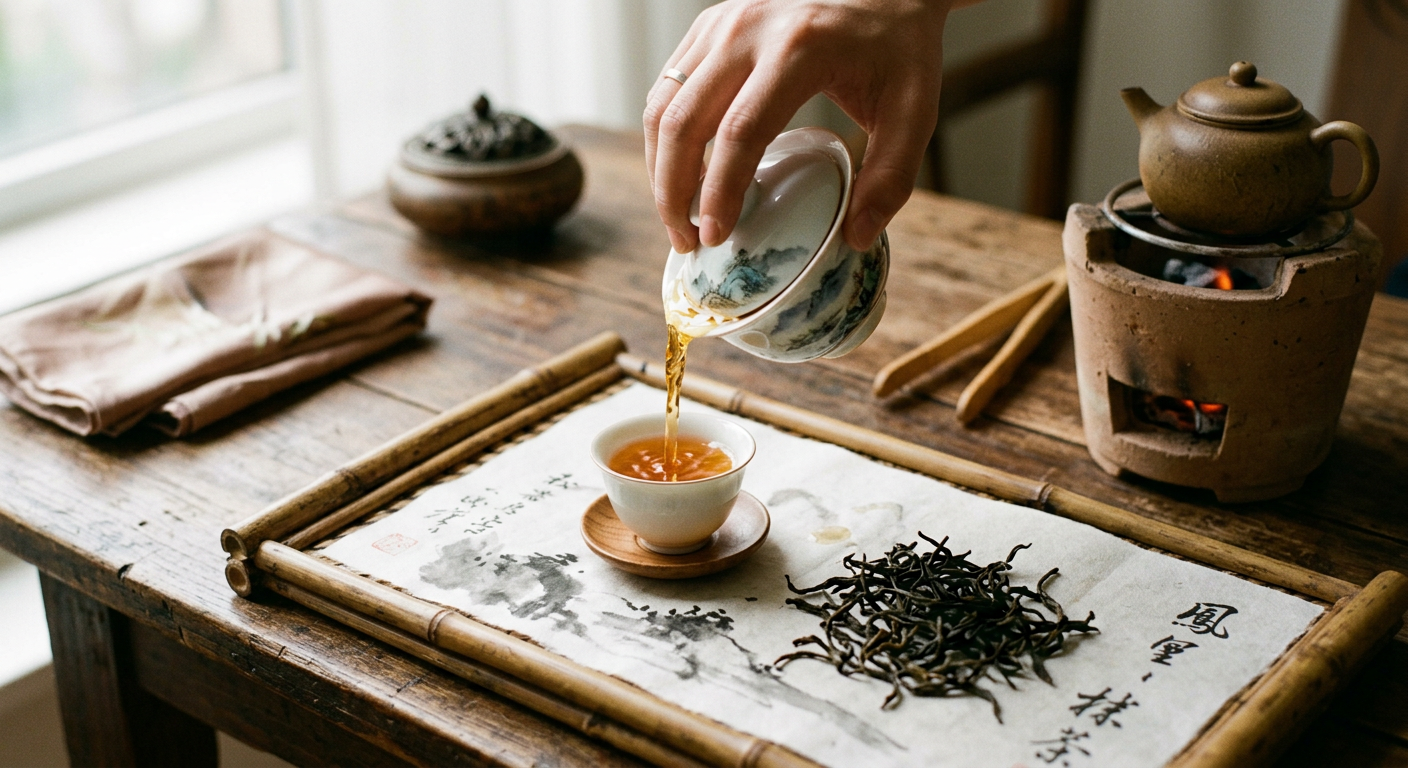
3. Rinse the leaves. Pour hot water over the leaves in a high, thin stream so the water agitates them evenly. Immediately pour the rinse into the pitcher and then over the cups or into the tea tray. This awakening rinse opens the leaves and removes surface dust. It is not drunk, though some hosts use it to warm the tea pet or cups.
4. The first infusion. Refill the gaiwan with water, again pouring from a slight height in a circular motion. Cover and steep for ten to fifteen seconds for an oolong. Pour completely into the fairness pitcher, then into the cups.
5. Subsequent infusions. Add five to ten seconds to each steep. The early cups are bright and aromatic; the middle cups deepen into sweetness and body; the later cups soften into honey, mineral, or wood notes. A good oolong will yield eight to twelve infusions, sometimes more.
The traditional Chaozhou ceremony has poetic names for these serving motions. Guan Gong Xun Cheng (关公巡城) means pouring in a slow circle around the cups so each receives the same strength. Han Xin Dian Bing (韩信点兵) means tapping the last drops from the gaiwan into the cups so nothing is wasted[source:2]. You do not need to announce them, but knowing them helps you pour with attention.
Serving with grace
In Chaoshan, people say "eat tea" (食茶) rather than "drink tea." The host offers each cup with both hands; the guest receives it with both hands in return. The first sip is small, the second deeper, the third finishes the cup. This three-sip rhythm gives the tea time to move across the tongue and reveal its layers[source:1].
Keep the conversation light, but stay present. Refill the kettle before it runs low. Watch your guests' cups and offer the next round before they ask. The role of the host is not to perform but to hold the rhythm. If someone is new to Gongfu Cha, tell them only what they need to know: "Small sips," "The later infusions are often sweeter," "Tap the cup gently if you do not want more."
Reading each infusion
A Gongfu session is a conversation with the leaf. Each infusion is a slightly different sentence. As the host, pay attention to:
- Color. The first pour may be pale gold; by the third or fourth it will deepen. Sudden cloudiness or dullness can mean over-steeping or too much leaf.
- Aroma. Smell the inside of the gaiwan lid after each pour. That lid aroma is often more vivid than the liquor itself and is one of the great pleasures of Gongfu Cha.
- Texture. Is the liquor thin, coating, silky, or astringent? Astringency usually means the water is too cool for the leaf amount or the steep was too long.
- Aftertaste. The Chinese call the returning sweetness huigan (回甘). A good oolong leaves a clean, sweet echo at the back of the throat long after the cup is empty.
If the tea tastes bitter, shorten the next infusion. If it tastes weak, add a few seconds or a little more leaf. There is no single correct time; there is only the tea in front of you and the water you just poured.
Conclusion
Learning how to host a Gongfu tea ceremony step by step is less about mastering a ritual and more about learning to pay attention. The small cups, the repeated infusions, and the quiet hospitality all point in the same direction: toward the leaf, the water, and the people sharing the table.
Start simply. A gaiwan, a pitcher, three cups, good water, and a roasted oolong. Warm everything. Rinse the leaves. Pour short. Watch how the tea changes across ten infusions. By the time the kettle has cooled, you will have hosted more than a tea session; you will have offered your guests a small, deliberate pause in the middle of a hurried world.